That paper cup you’re holding? It started as a public health hack and now shapes billion-dollar export deals.
Convenience Takes Over
Post-war suburbia and car culture rewrote the rules. Drive-in burger joints needed something that wouldn’t smash on dashboards. Paper cups delivered. Factories swapped wax for a thin plastic skin so coffee stayed hot without soaking through. Machines stamped, rolled, and glued at thousands per minute. Logos bloomed in bright inks. Europe discovered espresso in paper; Japan paired canned coffee with a tear-off lid. By the late century, the planet was burning through a quarter-trillion cups a year—raw boards from Nordic forests, liners from Gulf Coast refineries, finished pallets leaving Shenzhen docks bound for every port that served caffeine.
Waste Hits Hard
The trouble showed up in drone shots—mountains of cups in open dumps, plastic coatings laughing at rot. Cities struck first: foam bans in Seattle, carrier-bag fees in Dublin. Shoppers started asking baristas for ceramic if they planned to linger. Suppliers felt the squeeze. A single viral photo of a turtle tangled in a cup sleeve could tank a brand overnight.
The response rolled out in stages:
- Material swaps. PLA (polylactic acid) linings from corn starch replaced petroleum plastic in premium lines.
- Fiber sourcing. FSC-certified pulp became standard; some mills switched to bamboo or bagasse (sugarcane waste) for faster renewability.
- Design tweaks. Thinner gauges cut raw material 15–20 %; embossed sidewalls improved insulation, reducing the need for sleeves.
- Recovery loops. Industrial composting facilities in the Netherlands and South Korea turned used cups into park benches; chemical recycling pilots in Japan extracted clean pulp for reuse.
Today’s Export Game
For suppliers shipping disposable tableware overseas, sustainability isn’t a checkbox—it’s a tariff negotiator. EU’s Single-Use Plastics Directive phases out plastic-lined cups by 2030 unless they hit 90 % collection rates. Similar rules are drafting in California, Canada, and India. Buyers now ask three questions before price:
- What’s the lining?
- Can you prove renewable fiber?
- Do you have take-back certification?
Mills in Sweden run on hydroelectric power; coating plants in Southeast Asia switch to bio-wax. Factories print with soy-based inks and water-based adhesives to pass compostability standard EN 13432. The extra cost—roughly 8–12 % over traditional cups—gets absorbed because the alternative is losing shelf space in Whole Foods or Tesco.
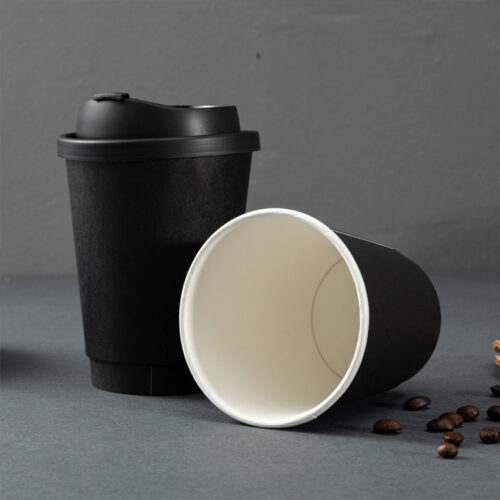
At Hyde Nature, we stock PLA-lined, FSC-certified cups built for these regulations—minimum 100,000 units, mixed pallets available for testing.
Tomorrow’s Edge
Pilot projects hint at what’s next: paper bottles with waterproof monolayers, edible starch-based lids, QR codes that trigger deposit refunds when scanned at reverse-vending machines. Start-ups in Tel Aviv and Shenzhen are testing mycelium-reinforced rims that sprout mushrooms if accidentally littered.
Scale remains the hurdle. A PLA-lined cup only beats PE on price at 100,000+ units. That’s why we bundle certifications—BPI Compostable, OK Home Compost, TUV Austria—and offer mixed pallets so small roasters or event planners can trial without over-committing.
Bottom Line
Paper cups began as a sanitary afterthought. They became icons of convenience. Now they stand at the intersection of regulation, consumer values, and circular design. Suppliers who treat sustainability as engineering rather than PR will capture the contracts that matter—whether fulfilling a Berlin café chain’s 3 million-unit tender or a Los Angeles festival’s zero-waste mandate.
Your cup still holds coffee for ten minutes. Now the next 10,000 days decide who gets the order.
Ready to ship compliant? Explore our full range at Hyde Nature Paper Cups.