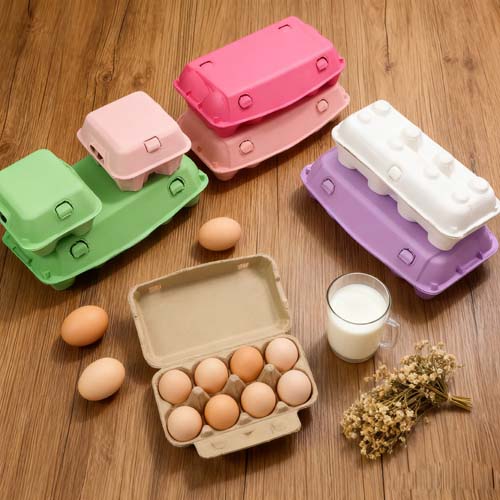
Most folks think of paper egg trays as nothing more than flimsy holders for breakfast eggs. Yet when people start piling things on top during casual experiments, the results often catch everyone off guard. These simple molded pulp containers, usually tossed after one use, can actually support surprising amounts of weight before they start to cave in.
Everyday 30-cell trays—the kind farms and supermarkets use—frequently manage 18–35 pounds (roughly 8–16 kg) in real stacking tests carried out at home or in small workshops. Smaller six- or twelve-cell versions typically top out lower, somewhere between 4–12 pounds depending on how the load is applied. Higher-grade trays with thicker walls or extra ribbing sometimes push past 45 pounds under even pressure.
What Gives These Trays Unexpected Toughness?
These trays rely on smart engineering using minimal raw stuff instead of bulky heaviness. Manufacturers pulp up waste paper like old newsprint, discarded boxes, or leftovers from crops such as bagasse from sugarcane. The slurry gets vacuum-formed into shape inside heated molds, then dried to create a firm, feather-light piece.
The individual egg compartments go beyond simple holding spots—they work like small curved braces or vaulted sections. Downward pressure gets channeled along the sloped edges and rounded bases, spreading the stress outward and away from any single weak point, similar to how arched roofs in historic buildings distribute massive overhead weight across supports without buckling.
Thickness varies intentionally throughout the structure too. Areas at the base of each pocket compact more densely during the forming process for solid footing, whereas the connecting partitions remain thinner and somewhat bendy to handle minor impacts or vibrations gracefully. Uniform loading across the surface lets this setup perform impressively well. Off-balance forces or exposure to damp air cut capacity quickly, though—sometimes dropping it by 50% or even more when humidity soaks in.
Easy DIY Experiment to Test It Yourself
Curious how your own trays hold up? Here’s a straightforward way to check without fancy equipment.
- Flip one tray so the open cells face upward (this orientation usually gives the best support).
- Set it on a hard, level floor or table.
- Place a flat piece of wood, thick cardboard, or a baking sheet across the top to distribute weight evenly.
- Start adding weight slowly—books work great because you can count them. Canned food, water jugs, or exercise weights also do the job.
- Watch closely for the first signs of trouble: sides bowing outward, bottom dimpling inward, or audible creaking.
In dozens of informal tests shared online and in packaging forums, a typical supermarket-grade 30-cell molded pulp egg tray begins deforming noticeably around 20–30 pounds. Trays made for export or industrial use, especially those labeled “heavy-duty” or made with longer fibers, regularly survive 40+ pounds before serious failure.
Variables That Change the Outcome
Several things swing the final number:
- Pulp source (longer virgin fibers or bamboo usually beat short recycled newsprint)
- Wall thickness (40–70 grams per tray makes a big difference)
- Cell depth and rib pattern
- Humidity level (trays stored in damp garages collapse much sooner)
- How perfectly the load spreads
Need Something Stronger? Custom Solutions Exist
Ordinary trays handle normal grocery trips and local deliveries just fine, but larger operations—egg producers, international shippers, or companies packing specialty or organic eggs—frequently look for extra safety margin. Made-to-order paper egg trays give you control over performance by fine-tuning the raw pulp blend, the mold geometry, overall thickness, and strategic rib locations, and everything remains fully biodegradable and recyclable.
Here at hydenature.com we create custom paper pulp egg packaging exactly to your specs. Looking for trays that can safely handle tall pallet stacks, hold up during long ocean voyages in varying climates, or accommodate unusual egg sizes? Send us your details—target weight capacity, expected stack height, shipment conditions, order volume—and we’ll develop prototypes, run strength estimates, and find the sweet spot between durability and cost.