Global foodservice operators, off-premise catering firms and cross-border food distributors are rapidly phasing out non-recyclable single-use plastics, pushing compostable paper packaging far past a marketing talking point to become a non-negotiable, auditable line item in every B2B procurement playbook. The 2025 EU SUPD supplementary rule locks in a 2027 hard deadline: every takeaway food and drink unit placed on the EU market must pass full industrial compostability validation, no exceptions. A 2026 independent foodservice sourcing survey also shows 72% of North American multi-location restaurant groups now rank third-party verified compostable packaging among their top three non-negotiable purchasing priorities. For B2B sourcing teams, the work is no longer just picking generic paper packaging — it is locking in products that deliver traceable compost performance, zero food safety risks, and rock-solid functionality for hot, oily, frozen and long-haul delivery menu items.
Core Analysis
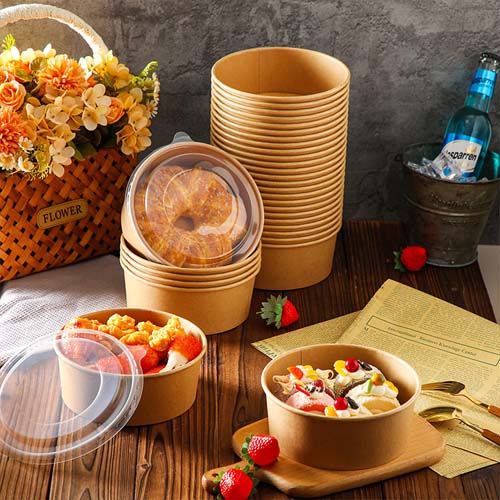
Compostable paper packaging refers to food-contact approved paper substrates engineered. Fully certified compostable variants, by contrast, can be tossed straight into food waste bins alongside leftover meals, cutting total landfill waste for mid-sized catering operations by up to 68%. Common SKUs in this category include leak-proof compostable paper bowls, stackable compostable paper food containers, fully tailored custom disposable food packaging for delivery fleets, and heat-resistant compostable paper lids built for both boiling hot coffee and sub-zero iced beverages.
Performance Comparison Table
| Packaging Type | Industrial Compost Time | Grease Resistance (ASTM D726) | Maximum Service Temperature |
| Standard PE-Coated Paper | >180 days (not fully degradable) | 2 hours | 70°C |
| Uncoated Kraft Paper | 45–60 days | <10 minutes | 80°C |
| Certified Compostable Paper Packaging | 90–120 days | 24+ hours | 120°C |
Data and Industry Standards
Two globally recognized, auditable standards define legitimate compostable paper packaging for cross-border B2B trade:
- EN 13432: The EU harmonized benchmark, requiring 90% of the material to break down into CO₂ within 180 days, with zero negative impact on finished compost nutrient levels.
- ASTM D6400: The US BPI certification rule, mandating full physical disintegration within 180 days in industrial compost conditions, and capping all regulated heavy metal content below 100ppm.
2026 third-party lab testing from the North American Compost Operators Alliance found 31% of uncertified “eco-labeled” paper packaging sold on global wholesale platforms fails EN 13432 checks, usually due to hidden plastic additives that stretch full degradation past 2 years. This makes sourcing from a transparent, audited compostable food containers manufacturer the only reliable way to avoid EU/US customs holds and regulatory fines.
FAQ
- If my operation only has access to local municipal compost drop-off points, will compostable paper packaging still break down properly?
- Most standard industrial-grade compostable paper packaging is formulated to fully break down in the 55–70°C sustained heat that municipal compost sites maintain, finishing full disintegration in 90 days. You only need to select extra home-compost-certified SKUs if your end customers are disposing of packaging in personal backyard bins.
- How do compostable paper packaging costs stack up against standard PE-coated paper for large annual B2B contracts?
- At 2026 global bulk wholesale volumes, fully certified compostable paper packaging carries a 12–18% unit cost premium over standard PE-lined paper. But for buyers operating in regions with EPR packaging taxes, the lower waste processing fees and plastic tax exemptions usually erase this price gap entirely within 12 months of switching.
- When I add custom branded printing to compostable paper packaging, what checks do I need to run to make sure I do not void its compost certification?
- You only need to confirm your supplier uses 100% water-based, soy-derived food-safe inks. Petroleum-based solvent inks leave non-degradable residues that will fail EN 13432 lab testing, so always ask for a printed sample’s accompanying ink safety report before approving mass production.
Why Choose Hydenature
As a specialized compostable food containers manufacturer focused exclusively on foodservice disposables, Hydenature engineers every unit of compostable paper packaging to meet strict global regulatory rules and real-world catering performance demands.
Custom Manufacturing Capabilities
We provide custom size, custom printing, low MOQ support, OEM & ODM service, and bulk wholesale supply for global buyers. Whatever you serve daily, we’ve got the sturdy, compostable, zero-waste version waiting.