The Rising Shift in Takeaway Packaging
If you’ve run a restaurant or takeaway operation for more than two years, you’ve almost certainly had this happen: a regular customer posts a photo of a leaking noodle box on your social media, or your local waste officer drops by to remind you the new single-use plastic ban kicks in in three months. What started as a small, “nice to have” packaging tweak has turned into one of the most frequent pain points for kitchen managers and procurement leads I talk to every week.
Core Material and Performance Breakdown
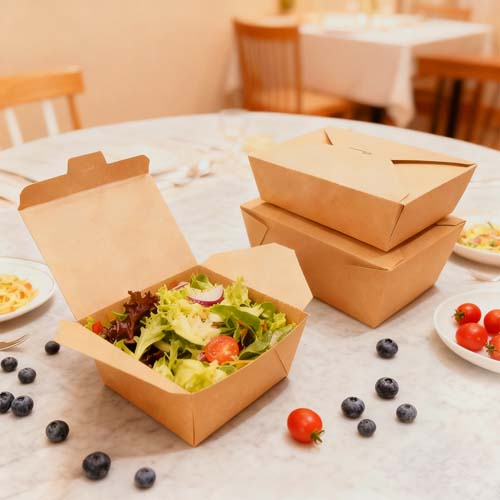
Paper food containers refer to single-use food service vessels made from virgin or post-consumer recycled paperboard, coated or treated to resist grease, moisture, and high temperatures during food storage, delivery, and reheating. The three most widely used types on the market are uncoated kraft paper containers, PLA-lined paper food containers, and PE-lined paper food containers. Each carries distinct technical parameters that determine its suitability for different menu items.
A clear side-by-side comparison helps buyers avoid the common mistake of selecting a container that leaks under hot soup or fails compost certification:
| Container Type | Grease Resistance | Max Temperature Limit | Compostability | Typical Use Case |
| Uncoated Kraft Paper Container | 2-hour resistance to dry/oily food | 80°C | 100% home compostable | Dry pastries, sandwiches, cold salads |
| PLA-Lined Paper Food Container | 4-hour resistance to 30% oil content | 120°C | Certified industrial compostable | Hot noodles, fried items, microwave reheating |
| PE-Lined Paper Food Container | 6-hour resistance to 50% oil content | 130°C | Not compostable | Soups, stews, long-distance delivery |
Global Regulations and Industry Benchmarks
For international wholesale food packaging buyers, two non-negotiable standards must be verified before placing any bulk order.
- The first is EU EN 13432, the official standard for packaging recoverable through composting and biodegradation, which requires 90% of the material to break down into natural elements within 180 days.
- The second is FDA 21 CFR Part 176.170, which sets strict limits on the amount of soluble matter that can transfer from paper packaging to aqueous and fatty food.
Frequently Asked Questions
These are not generic textbook questions — they are the exact ones our customer support team fields every single week from restaurant owners who have already wasted time and money on bad packaging orders.
Can PLA-lined paper food containers go directly into a standard commercial microwave?
We get this one at least 15 times a week, usually from café owners who got burned by a cheap batch that warped all over their microwave last winter. The short answer is yes, but only if you’re using properly certified stock. Most food-safe PLA-lined paper food containers handle 120°C for 3 minutes perfectly fine, as long as you crack the lid a little to let steam escape. The no-go? Don’t shove a fully sealed one in for 10 minutes — that’s how you end up with a warped mess and a ruined lasagna.
Do custom printed paper food containers affect the food safety certification of the final product?
Only if the printer uses non-food-grade ink. All compliant custom disposable food packaging uses water-based food contact ink, which does not compromise EN 13432 or FDA certification and leaves no odor transfer to hot food.
Why Work With Hydenature
Unlike general wholesale food packaging platforms that only stock standard sizes, Hydenature focuses exclusively on food-contact-safe, plant-based paper food solutions built for high-volume restaurant and takeaway operations. Every batch of our paper food containers comes with full, traceable third-party test documentation, so you never face unexpected customs holds or compliance penalties. We design our product range to cover everything from cold salad bowls to double-compartment hot meal boxes, removing the need for you to source from three or four different suppliers to cover your full menu.
Final Takeaway
The best paper food container for your business is never the one with the lowest unit price, nor the one that carries the most eco-label buzzwords. It is the one that matches your menu’s temperature and grease profile, meets all local and international packaging regulations, and supports your brand’s promise of a clean, safe dining experience for every customer who orders takeaway.